I talk a lot about bee hotels (sometimes even for work), and one of the the most common visitor to UK bee hotels is the Red Mason bee (Osmia bicornis). They’re a reddish / ginger solitary bee a little smaller than a honeybee, and the distinctively ‘horned’ females make use mud to make their nesting cells. They’ve got patchier distribution in Scotland, but do seem to be spreading into Northern areas. So a good candidate for a bee hotel user representative.
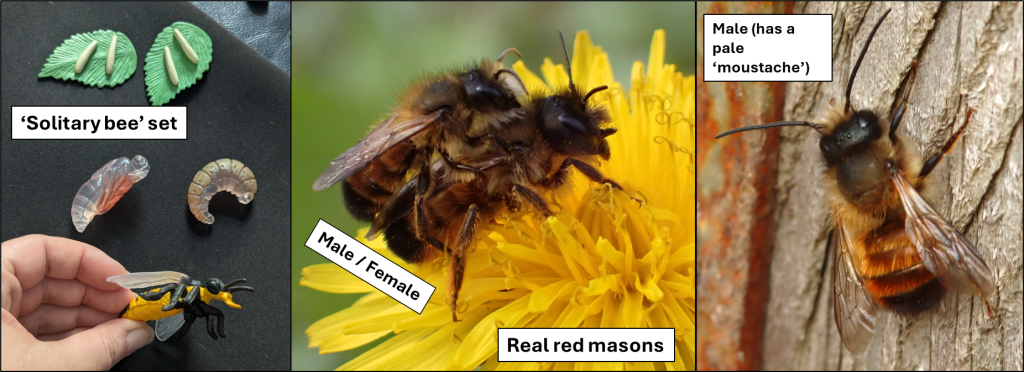
As I discussed earlier, there’s some work to do to make the easily-available lifecycle toys into what I want. The ones that arrived (above) came with 2x Long Leaf Eggs (no), slightly-shaded transparent larvae / pupae, and the sort of… beaked(?) bee sculpt, in a general yellow-black-stripy colour pattern. I want this to be a Red Mason bee, and to have some sort of ‘bee hotel’ element to it.
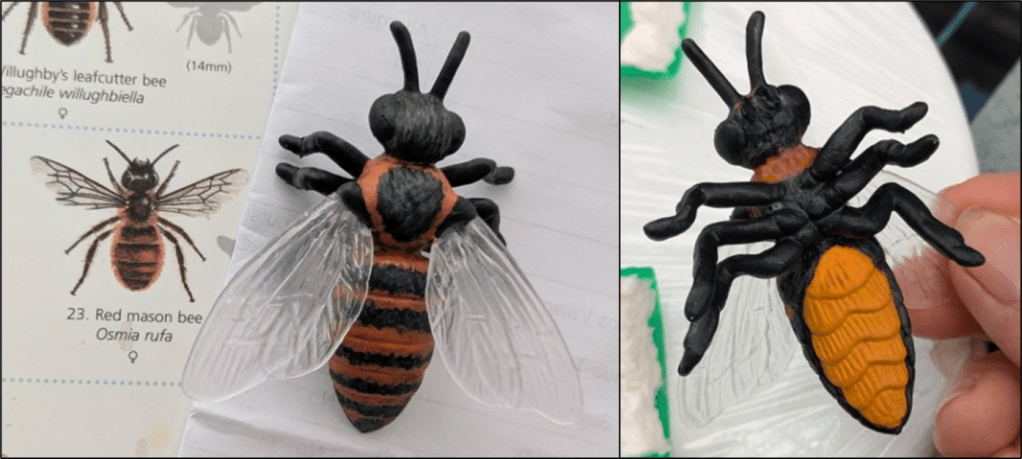
1) Trim the beak into the ‘horns’ of a female O.bicornis. The models are made of a rubbery plastic, so a pair of hobby clippers cut it easily. Once trimmed, coat the models in acrylic primer, so the new paint has a good surface to stick to, and repaint it.
(Did I forget to take a photo of this part of the process? Of course.)
2) Go through the Big Box of Plastic Bits to find something that the larvae fit in, which can be made into ‘bee hotel’ tubes, and half of a cocoon. Trim everything to size, then faff around with papier-mâché / milliput to make: cell walls, pollen mass, egg. Wait for ages for it to dry. Fill in gaps that form when dry, because you forgot that papier-mâché shrinks.

3). Discover it is weirdly harder to paint a half-decent ‘bamboo tube’ texture than a bee. Paint everything anyway, and varnish several times. Hopefully the flexible plastic won’t crack the paint off with the primer / varnish combo, but we shall see.

(Image credit for the photos on the right: “Osmia bicornis development stages (48325764237)” by Gilles San Martin from Namur, Belgium is licensed under CC BY-SA 2.0.
4) Finished!
I’m really happy with how these came out. Gonna make some little fact sheets / life cycle photo cards to go along with them too.
Next: Ladybirds.

 Gardens, bugs and science
Leave a comment