The 7-spot ladybird is one of our most recognizable ladybird species, and is probably the quintessential ladybird to many people. Red-orange, black legs, 7 black spots, two big white spots on the pronotum. It’s even the basis for the ladybird emoji 🐞🐞🐞 The lifecycle toys are clearly based on it, and aren’t anywhere near as escalatingly-weird as the bee ones are.
So why did I repaint mine to be a Harlequin Ladybird (Harmonia axyridis)? It’s not even a native species, and has caused documented problems for our native ladybirds.
Well, firstly, I will be doing a 7-spot life cycle repaint soon enough. But I think the existing schemes are (accidentally? Sort of?) meant to be harlequins – at least in the early stages, and it’s because of the sculpt of the pupae.
If you’ve never seen a ladybird larvae go into its pupae, it’s weirder than you think. Essentially the larvae fixes its bum down onto a suitable surface, then the pupal skin splits out of the old one. The old skin scrunches down to the base and ends up as a crumpled shed underneath the smooth pupae. Here’s a timelapse:
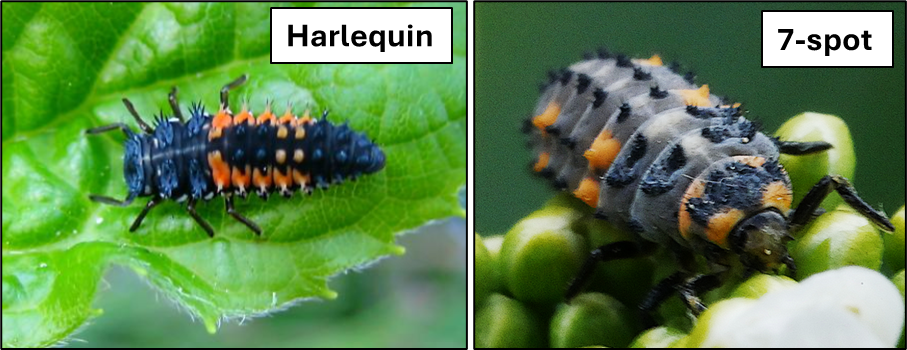
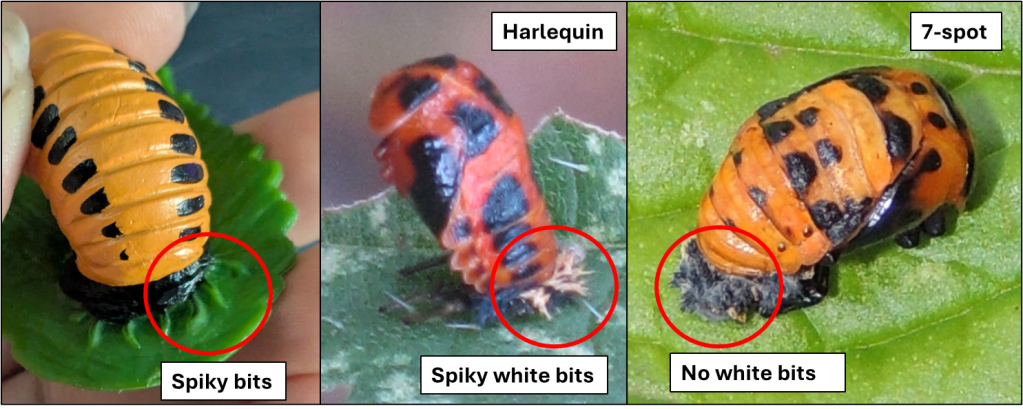
Since the leftover is a shed skin, you can still see some characteristics of the larvae that wore it. Harlequin larvae are very distinctive and have lots of long(ish) spiky bits on their backs, which are usually pretty visible on the bottom of their pupae too; 7-spot larvae don’t have these (and are also generally more grey in colour).
The ladybird lifecycle sculpt has quite long, spiky bits at the bottom of the pupae stage. (Not painted in the version I got, but there.)
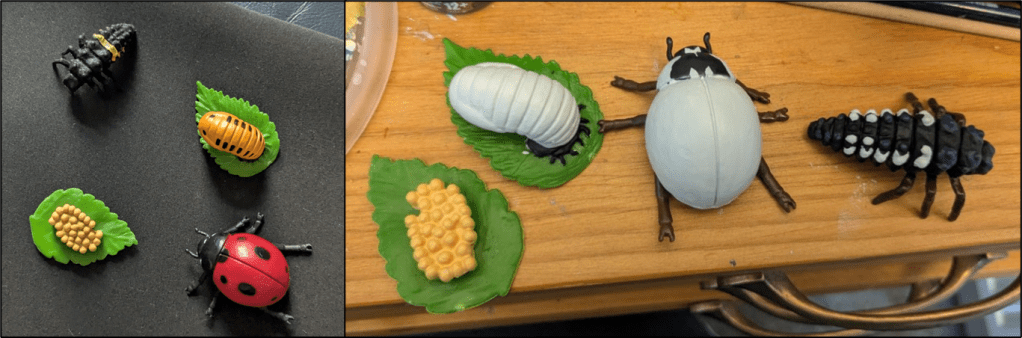
This doesn’t mean it is a Harlequin, but the idea got in my brain and so I wanted this one to be H.axyridis. For my own outreach needs, Harlequins are large, distinctive, and very common across most of the UK (spreading into Scotland currently). While they aren’t native, they are definitely something that folks are going to encounter easily, and I do get a lot of questions about them.
There was less to do than for the red mason bee; mostly just prime, pick a colour pattern (including the brown legs of the adults – important diagnostic feature!), and then varnish repeatedly.
Since Harlequins are very polymorphic in their colouration, I went with the common f. succinea pattern.
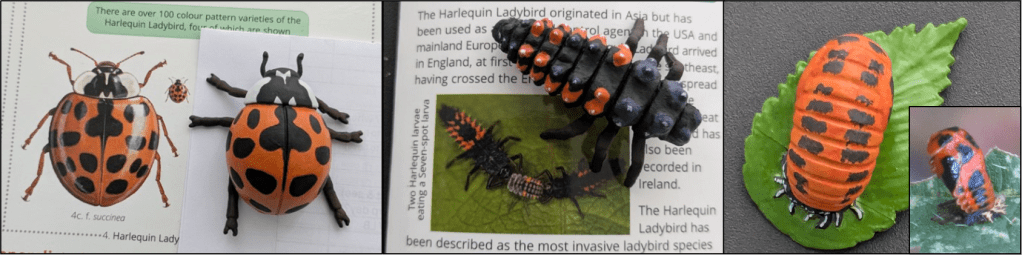
I am very pleased with these too! I do want to do a 7-spot version, but I’ll need to order a new one to pedantically repaint.


 Gardens, bugs and science
Leave a comment