I love a good outreach activity and (as the state of my shelves will attest) I really love a little model of something. It’s a great way to illustrate what you’re talking about, particularly when what you’re talking about is something a) small, b) unusual or potentially hard to visualize, and c) sequential, like life cycles. They’re like 3D diagrams, that you can pick up and prod.
Also, I am considerably better at making / adjusting little models than I am at any form of drawing. Making things out of powerpoint shapes can only take you so far.
So since I’m doing my own activities now, I have an excuse to up my collection of Cool Bug Models (up from the previous combo of ‘Things from the Halloween Section’, ‘Goth Tat (Realistic)’, and ‘Oddly-specific Museum Gift Shop Delights’). Into an internet rabbit hole I go, looking for models that are accurate (enough, or could be modified), representative of local critters (UK ideally), and viable on a self-employed budget.
There is… a lot going on.
1. Plagiarism ahoy! I have no idea how you’d even start looking up the provenance of a 3D model design, but there are clearly a lot of knock-offs of the knock-offs, knocking-off. For example, I’m pretty sure that the spider in this ebay/unbranded ‘Spider Life cycle’ is a clone of the Papo ‘Tarantula’ (actually the Original Tarantula, the wolf spider Lycosa tarantula).
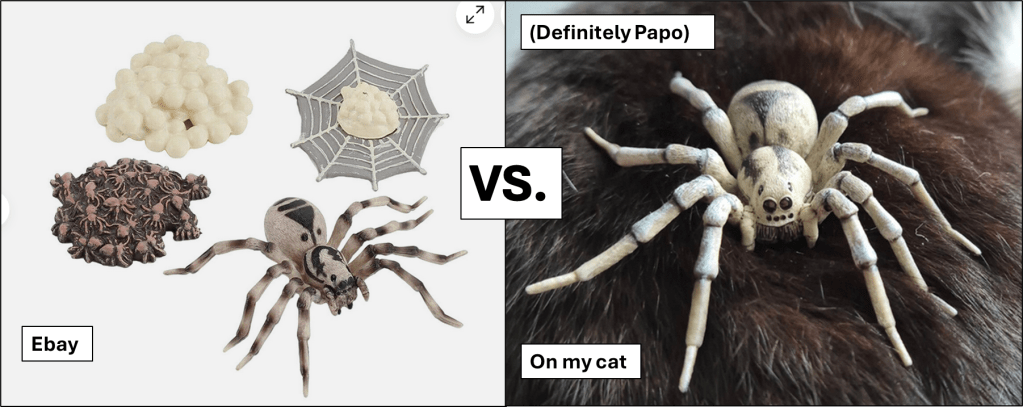
Also that’s… not how wolf spider eggs work. Or tarantula eggs. Or, really, any spider eggs at all – they lay eggs inside protective egg sacs (which can be really elaborate), not in A Heap, and certainly not in the middle of a web! The web is a hunting tool. Do not keep your babies in it.
2. Very America-centric. Bit of a peeve of mine for bug things in general, is that most insect models are based on bugs found in America. So many ‘butterfly’ and ‘moth’ life cycles are specifically the Monarch butterfly or Luna moth – and yes, they’re gorgeous and fascinating, but we don’t get them in the UK. We’re illustrating life cycles of very conspicuous and important types of critter, with species that kids will not see in the natural world around them. It’s disappointing, and I worry that it only adds to the idea that Wildlife Happens Elsewhere.
Weirdly, except for ladybirds. The 7-spot ladybird seems to be the Platonic Ideal Ladybird even for the US, even if they’ve only been present there since ~1950s and are an introduced species.
3. The Bee Randomiser. There are a few models of egg / larvae / adult bees used everywere, which honestly seem to be assigned randomly to each other as life cycles. Also one wasp (which I think is a Polistes paper wasp, not a parasitoid), and a very sad caterpillar (likely a parasitised hornworm). These proposed life cycles are… variable.
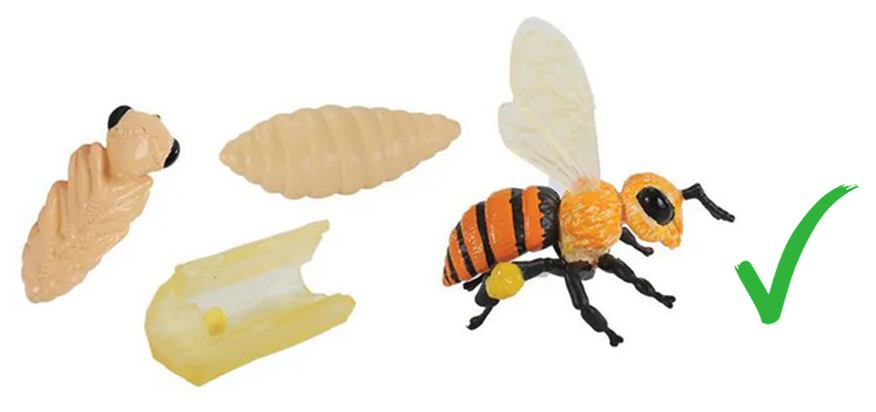
‘Insect Lore‘ honeybee life cycle. Wax cell for egg! Immature larvae fits in cell. Adult right shape (+ pollen baskets).

A bumblebee? Why are the eggs so long? Why are they loose on a leaf? These are the typical ‘larvae’ and ‘pupae’ sculpts, which are good, but just… around. Contextless. Nude?

The most common bee shape. Solitary bee? Doesn’t look chunky enough for bumblebee.
Why is the egg so long and transparent? It’s in some sort of trough. Comb cell? Bee hotel?
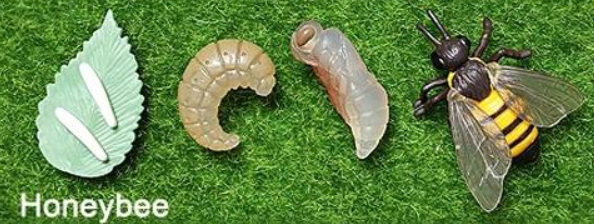
<- No.
And finally, the most baffling combination I found:
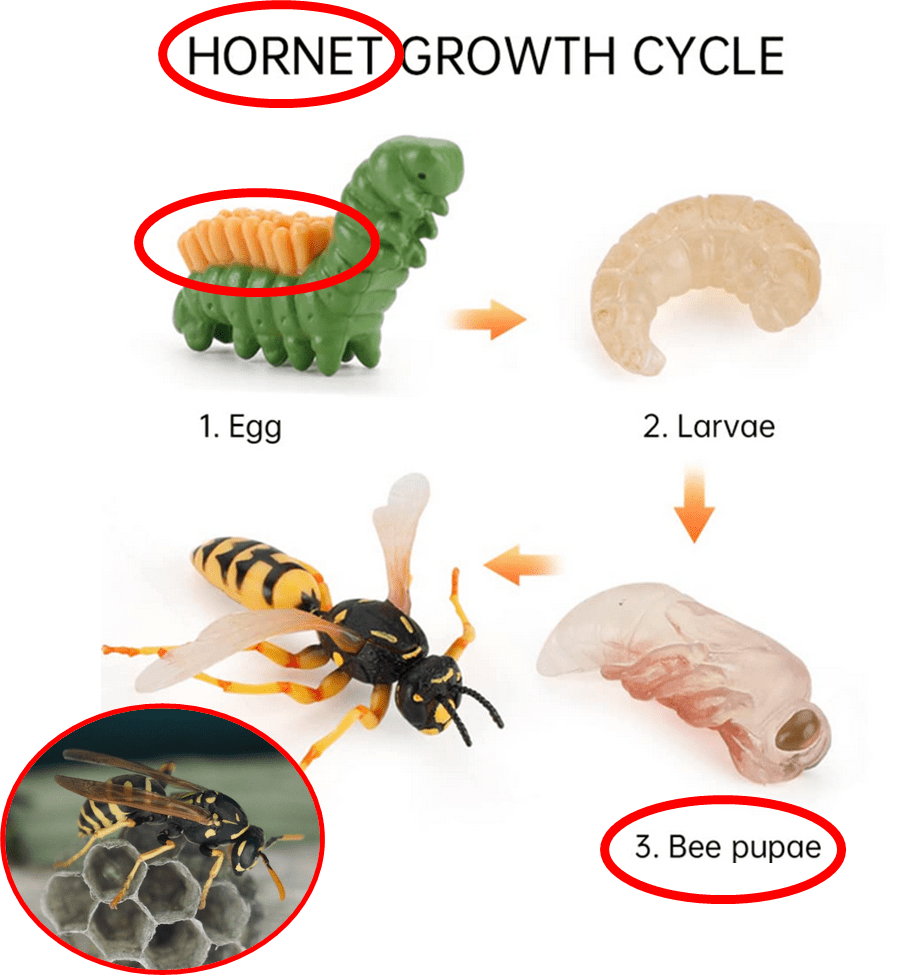
SPIN THE BEE RANDOMISER!
These labels make no sense. Nothing to do with hornets. That is a parasitised hornworm caterpillar. The lumps coming out of it would be braconid parasitoid wasp larvae / cocoons, so 2 & 3 don’t need to exist. Adult is from a completely different Family of wasps (inset image of Polistes), looks nothing like a braconid, and has a completely different life cycle.
So. Other than adding another topic to my Oddly Specific Rants ensemble, what to do. I still want life cycle toys, but I have Opinions.
And there’s a whole load of tabletop miniature wargaming* crafting supplies across the room from my work desk…
(to be continued)
* I live in Nottingham; what can I say?

 Gardens, bugs and science
Leave a comment